SYSTEM · GRIOT FINANCE
STATUS · STAGE TWO RUNNING
The
Purse.
A hundred-year-old book about a four-thousand-year-old city —
and the Saturday message that keeps me honest.
Seven cures,
four thousand years.
In 1926, a Denver businessman named George S. Clason started publishing little pamphlets about money, and banks handed them out the way pharmacies hand out vitamins. The pamphlets became a book, and the book became one of those objects that never goes out of print: The Richest Man in Babylon. It is not a book of charts. It is a book of parables, set in the ancient city where writing itself was invented — where a man's accounts were pressed into wet clay and left to dry into permanence.
The best of the parables opens with a chariot builder named Bansir sitting on a low wall, staring at the unfinished chariot he has no heart to finish, running the arithmetic of his own life: thirty years of skilled work, and nothing kept. His friend Kobbi, a musician, is in the same shape. So they do the thing men rarely do — they go and ask. They walk to the house of Arkad, the richest man in Babylon, a man who started as a tablet-copier no more talented than they were, and they put the question to him straight: what do you know that we don't?
Arkad's answer is almost insulting in its simplicity, which is how you know it's real:
Not the part that's left over. The first part. One coin in ten, taken off the top before the world files its claims. From there the book unfolds Arkad's full doctrine — the Seven Cures for a Lean Purse — and it has been one of my favorite books on money since the first time I read it, because it is the only personal finance book I know whose entire operating manual fits on a clay tablet:
- 01 Start thy purse to fattening — keep one-tenth of all you earn STAGE ONE · LIVE
- 02 Control thy expenditures — necessities are not desires STAGE TWO · RUNNING
- 03 Make thy gold multiply — put the tenth itself to work QUEUED
- 04 Guard thy treasures from loss — no deals too good to question QUEUED
- 05 Make of thy dwelling a profitable investment QUEUED
- 06 Insure a future income — provide ahead, for age and family QUEUED
- 07 Increase thy ability to earn — sharpen the craft itself QUEUED
You noticed the status column. Hold that thought — it's the whole story.

Knowing
isn't running.
This June I was deep in a reorganization sweep — the season where I finally opened every box, every folder, every drawer that had been promising to organize itself. And in the middle of it, there it was: my copy of The Richest Man in Babylon. I stopped the way you stop when a book looks back at you.
Because here is the uncomfortable inventory I ran, standing there with it in my hand. I build systems for a living. My clients' operations run on infrastructure I designed to never forget anything. My own calendar, my health, my projects — all of it watched by machinery I built. And the best money advice I have ever read was sitting on a shelf, in ink, exactly as inert as the day it was printed. I agreed with the book. I had agreed with it for years. Agreement, it turns out, compounds at zero percent.
That's the quiet mechanism underneath most financial failure, and I've watched it in operators far sharper than me: knowledge doesn't fail loudly. You nod at a principle, and the nod feels like action. The gap between knowing and running never announces itself. It just bills you monthly.
And the modern economy is engineered — precisely, professionally engineered — for that gap. Arkad never met an auto-renew. Every subscription you hold is a small bet, placed by someone else, that you will not look. Your banking app shows you a balance, never a direction. The merchants of Babylon had to convince you in the marketplace, face to face, every single time; ours convince you once and then charge you forever. Nobody selling to you wants your expenses examined. They want them ambient.
Babylon's scribes pressed their accounts into wet clay because they understood something we keep forgetting: the purse lies when nobody writes things down. Four thousand years later the clay is a spreadsheet, and the lie is exactly the same.
So, standing in front of that shelf, I made the same call I make with clients who know their business better than anyone and still watch it leak: stop trying to be a better reader. Give the book a runtime. Not re-read it. Install it.
Before the build,
the interview.
I brought the idea to Claude — the AI I build with every day. And here is the part I most want non-technical readers to catch, because it is the part everyone skips: the first move wasn't code. It was an interview.
I've written before about the protocol I run before any real work — Context, Role, Interview, Task. The heart of it is the third step: before the machine builds anything, it questions me, one question at a time, each answer steering the next. It sounds ceremonial until you watch what it does to a plan. My first plan, the one I walked in with, was "build a Babylon app." Ambitious. Shiny. Wrong.
GRIOT — my voice assistant — already logs expenses into the spreadsheet my accountant keeps.
> Then why build anything new?
...exactly. Extend what runs. Don't duplicate it.
> All seven cures at once?
No. One. The first. Until it holds.
> Where does the tenth actually go?
A savings account I already own. No new apps. No new logins.
> And who catches you when you drift?
The system does. Saturday morning. In writing.
Five questions in, the shiny app was dead and something better stood in its place. The plan came out three decisions long:
One coin in ten,
spoken aloud.
Stage One went live at the end of June, and it is small on purpose: a ledger with six columns, a voice line, and a Saturday message. That's the whole machine.
When a client payment lands, I say it out loud. That's the ritual. GRIOT — the assistant I named for the West African keepers of memory — writes the row and answers back with exactly one number: the tenth.
"GRIOT — log income. Thirty-five hundred. Client payment."
ROW WRITTEN · AMOUNT $3,500 · THE TENTH: $350
"A part of all you earn is yours to keep. Move $350."
set-aside: PENDING
Pending — because the system does not move the money. I do. That is deliberate architecture, not a missing feature. The tenth travels to a plain high-yield savings account by my own hand, and then I tell GRIOT to mark it confirmed. The machine keeps the score. The human keeps the agency. Babylon's rule, Babylon's division of labor: the scribe records, the man decides.

Then, every Saturday at nine in the morning, a message finds me in two places — my inbox and my phone. What came in this week. What the tenth was. What has actually moved, and what is still pending. Thirty seconds to read. Impossible to misunderstand.
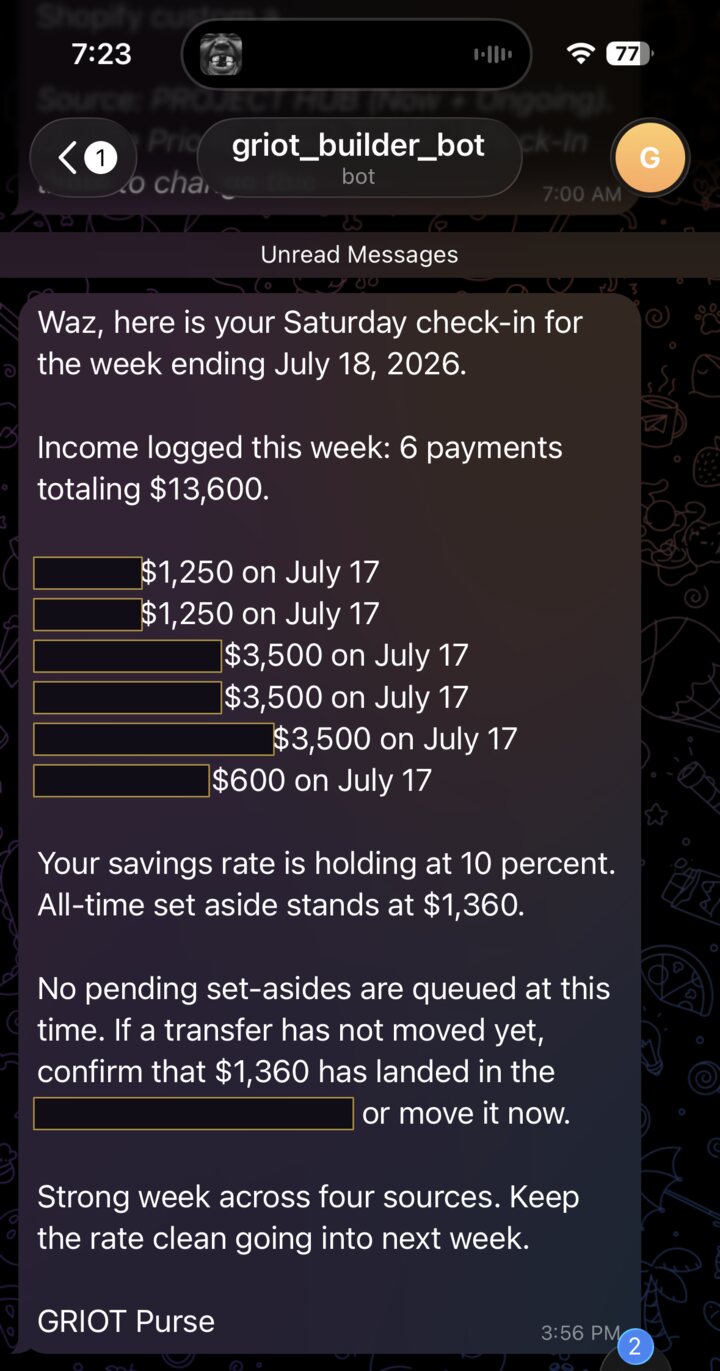
READ THE THIRD PARAGRAPH TWICE. IT REPORTS THE LEDGER, THEN ASKS ME TO CONFIRM REALITY.
THE $360 WAS LIVING IN THE GAP BETWEEN THOSE TWO SENTENCES.
Now the honest part — because a money story that skips the honest part is a brochure.
In its first stretch, six payments went through the purse: $13,600 of income. The tenth: $1,360. And when I audited the record against a second copy I keep in another tool, the truth surfaced: only $1,000 had actually made the trip to savings. I had marked rows "moved" faster than my hands had moved the money — $360 of optimism, sitting in a checking account, pretending. I lied to my ledger the way everyone lies to their ledger: hopefully, and in small denominations.
Here's the thing. The old me wouldn't have known there was a gap — wouldn't have known there was a number to be wrong about. The system's job was never to prevent the lie. It's to make the lie visible by Saturday. The machine doesn't shame me. It just refuses to lie with me.
One more confession while we're here: the Saturday message itself broke twice in its first month — once loudly, once silently, which is the worse way. Both times, the repair took an evening with Claude. I mention it because that is what living systems look like. They earn trust not by never breaking, but by breaking in front of you and getting repaired in daylight.
Necessity, desire,
and eighty labels.
Cure Two is where Arkad stops being gentle. His warning is the sharpest sentence in the book:
Confuse not the necessary expenses with thy desires. Easy to nod at. Nearly impossible to see in your own ledger — which is why Stage Two began the way Stage One did: not with willpower, but with a reading of the record. Last week I had Claude walk every expense row of this year. All of them.
The first pass came back with my "desire burn" — the spending that was want dressed as need: $536 for the entire year so far. I would love to tell you I am simply that disciplined. The truth is funnier. Nearly all of that $536 turned out to be a cloud storage bill that had been filed, at some point, by someone, under Meals & Entertainment. The scandal wasn't indulgence. The scandal was mislabeling.
And that was the real finding — the one that reframed the whole stage. My spending isn't wild. It's unexamined. Eighty different labels on one year of expenses. Thousands of dollars asleep in a pile called "Subscription" that no one ever sorted into necessity or desire. Thousands more across seventeen vendors carrying no label at all. The machine did what machines do best: it found every place where a human had never actually made a decision.

So now the machine has handed the stylus back. Sitting on my desk are five judgment calls it refuses to make for me — which of the AI tools I pay for are infrastructure and which are toys; what the travel really was; where the line runs between the business's appetite and my own. It can count anything. It cannot want for me. That part of the tablet, only I can press.
And that is where this story stops — mid-stage, on purpose. The tenth is being kept; that habit has held. The expenses are on the scale right now. By the next installment I will have made the five calls, taught them to the Saturday message, and I will finally know a number I have never known in my adult life: what my desires cost, exactly, in dollars per month.
I'll tell you what the scale says. — to be continued.
Your own purse,
one session.
Like The Handoff, this story comes with the kit. Not a program you subscribe to. Not my login, my server, or my spreadsheet — a folder of instructions your own Claude reads, so it can build your Stage One, on your machine, holding your numbers, answering to no one but you.
You need less than you think:
The install is one sentence. Open Claude Code and say:
Claude clones the kit, reads the protocol, and — before it builds anything — interviews you. Where income arrives. What counts as income. Where your tenth will live. Who your witness is — the kit can stand up a weekly check-in by email or Telegram, and drafts the message in your voice, not mine. The same discipline from Act III, running for you.
- S1 The Ledger — interview, ledger built, first payment logged 45–60 MIN
- S2 The Witness — the weekly check-in that speaks first 30 MIN
- S3 The Voice — optional: the automation track, for later WHEN READY
advanced/ folder holds sanitized versions of my actual voice-and-automation workflows for whenever you outgrow manual. Start manual. The book did.Checkpoint: you're done with Stage One when a real payment has been logged, a real tenth has moved to somewhere it can quietly grow, and one scheduled message has found you without you touching anything. From there, you and I are on the same road — I'm just one cure ahead, leaving markers.
Somewhere in Babylon, four thousand years ago, a scribe pressed a merchant's accounts into wet clay and set the tablet in the sun — because he understood what I am relearning one Saturday at a time: memory is the first financial instrument. Every cure in the book depends on a record that doesn't flatter you.
Keep the tenth. Label your desires honestly. And get yourself a witness that writes things down — clay, spreadsheet, or a voice named after the keepers of memory.
Stage Two's numbers are coming. I'll report back.
— Waz
The Richest Man in Babylon is by George S. Clason, 1926 — in print ever since, and in the public domain in most of the world. Buy a paper copy. Put it where you'll see it again.