WRITTEN INTO CLAUDE.MD · JUL 15
STATUS · INTERVIEWS EVERY SESSION
The Interview.
I stopped prompting my AI —
and instead let it interview me.
Then Geoff Said
The Sentence.
This past Wednesday, I had a livestream open in one tab and four other tabs open on other people's problems, which is how most of my Wednesdays go. A guy named Geoff Woods was on screen talking to a guy named Andrew, and somewhere behind Andrew's questions sat an AI persona called Boardy, chiming in every few minutes like a very well-read intern. I wasn't watching for me. I watch these the way I watch most of them — for a line I can hand a client.
Then Geoff said the sentence.
I froze in my chair and began listening eagerly.
He had a name for the move: context, role, interview, task. Four words, sticky-noted to his desk in Sharpie.
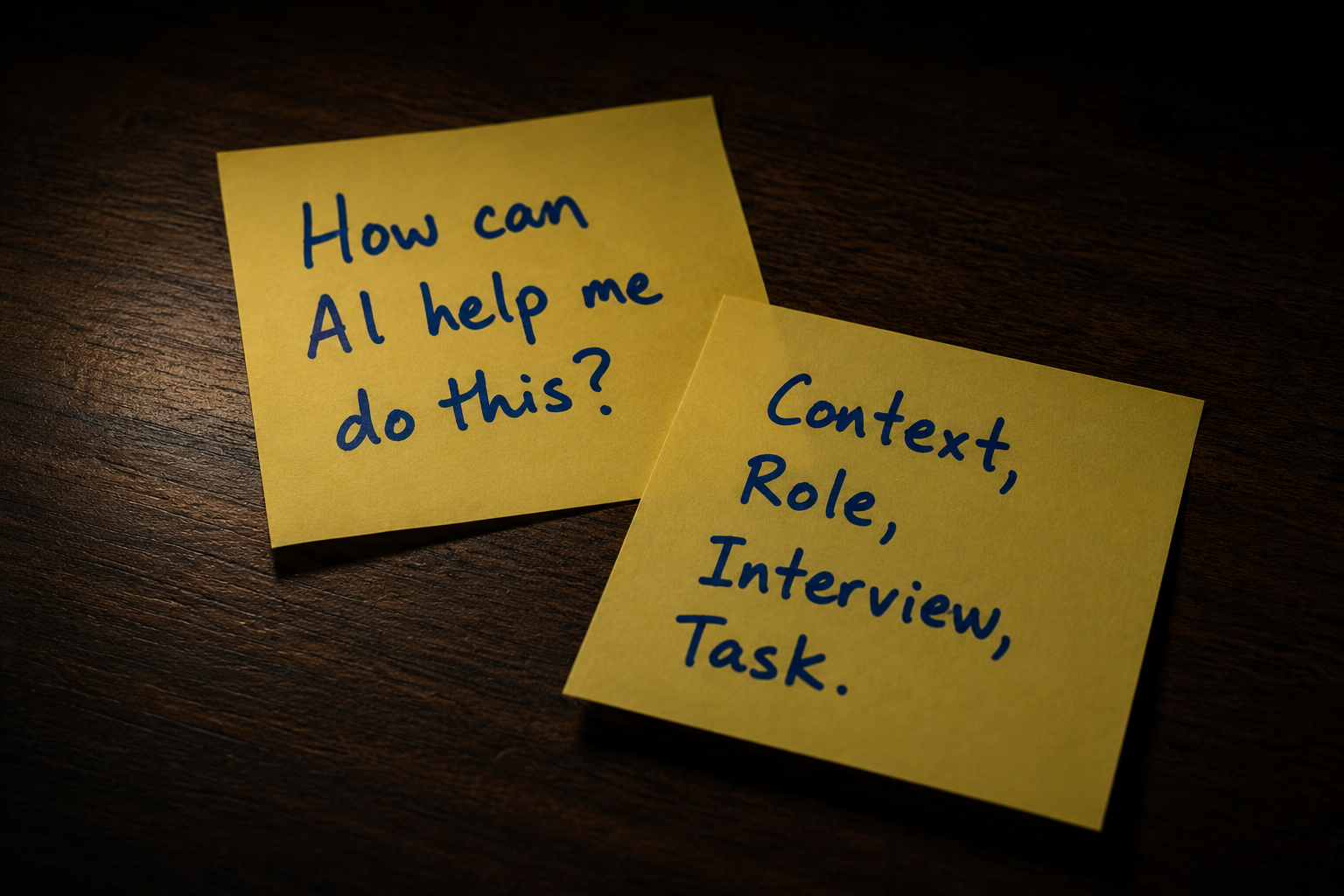
I went back later to clean up the transcript and noticed the note-taker — an AI, transcribing an AI conversation, in the background of my own AI session — had misheard him. It typed "CREP." The framework that exists specifically to stop you from trusting a first draft got its own name wrong on the first draft. I left that detail in on purpose. It's the whole story in miniature.
Geoff told the room about a manufacturing CEO he knew — ninety days without real sleep, a Japanese public-company board refusing to restructure a debt that was sinking the business, five consultants and five strategies already spent. Geoff opened a blank chat window in front of him.
CONTEXT — the debt, the board, the five failed strategies. Paragraphs, not a search query.
ROLE — an investment banker who understood two thousand years of Japanese business culture.
INTERVIEW ME — ask one question at a time, up to three, before you tell me anything.
──────────────────────────────
1 sec later → "Do you have any relationships with other executives in Japan the board would respect?"
The CEO's exact word for it was "remarkable." Two months later, a text: the ball is moving.
I've viewed countless AI related demos. This one landed differently, and I've been trying to figure out why ever since. I think it's because nothing about it was about the AI. The unlock was the third word. Interview.
By the time the stream ended, I had a breakdown of the talk already forming in a folder I named CRIT Doctrine before I'd even decided to keep it. By that evening, four words were sitting inside my CLAUDE.md — the file every one of my sessions reads before it does anything else — under a header I wrote half as a joke and kept because it wasn't one: Required at the Start of Every Workflow.
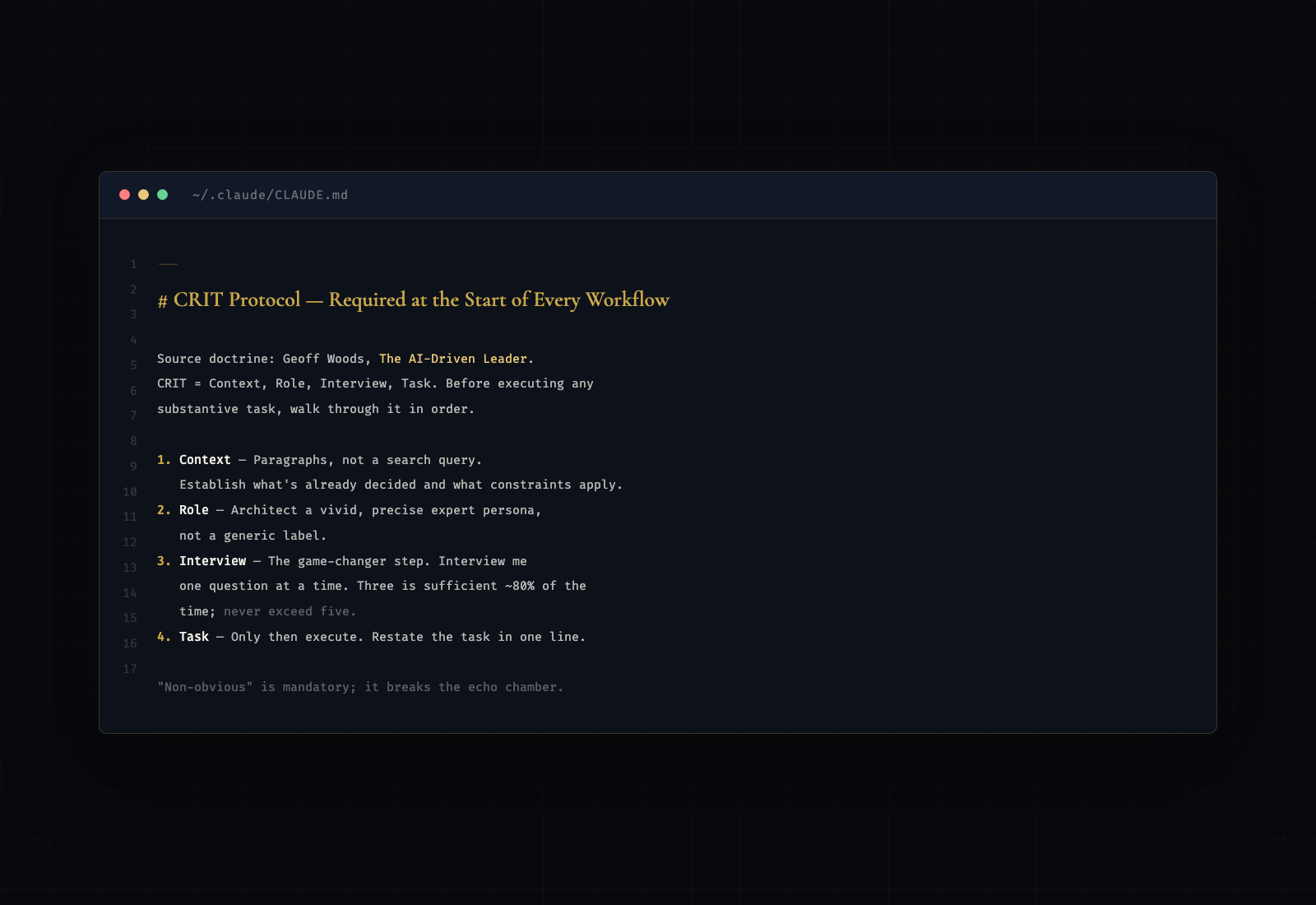
The System
Underneath.
Here's what actually changes when you add the third word. Context and Task, most people already do, badly — they type a request and hope. Role is a nice trick everyone's discovered by now; give the AI a costume and it performs better. None of that is the unlock. The unlock is refusing to let it answer you until it has interviewed you first.
Interview me. Ask one question at a time. That second instruction is the whole mechanism — it's what turns a monologue into a conversation. Ask everything at once and you get a form. Ask one thing, wait for the answer, let that answer choose the next question, and you get something closer to what a good consultant does in the first real meeting: they don't open with recommendations, they open with tell me more about that.
Three questions covers most of it. Go past five and the questions start pulling in things that don't belong, and the conversation gets harder to trust, not easier — Geoff was specific about that ceiling, and I've since watched it hold up in my own sessions more times than I can count. This piece you're reading started with four questions, not because the number is magic, but because four was what it took before I had enough to build from without guessing.
Geoff said something in the second half of the talk that I didn't expect and haven't stopped thinking about: this didn't just change his relationship with AI. It changed his relationship with people.
Once you've felt what it's like to be interviewed properly — one good question informing the next, instead of being handed a generic answer — you start noticing every time you skip that step with a human. Have I actually given my team enough context? Did I define the role I need from them, or just assign a task? Did I give them permission to ask me anything before they start? I already had a strategist, a builder, and an operator running pieces of my business before that Wednesday. Not one of them had ever once turned around and asked me a question before doing what I said.
Who Benefits From the Version
of You That Never Gets Interviewed.
Most software isn't built to make you work harder for a better answer. It's built to remove the friction between "I want something" and "here it is" — because friction is where people quit, and quitting is bad for the product. Auto-complete. Auto-summarize. One-click everything. The entire industry is optimized to answer you faster, not to ask you anything first.
Which means the version of you that stays comfortable — the one who opens a chat window and types a question the way you'd Google a fact — is the version every tool on your screen is quietly built to keep. It's not a conspiracy. It's just easier to sell "instant answer" than "answer that costs you fifteen minutes of being honest about what you actually know."
There's a second, quieter version of the same trap. Ask an AI a question and it wants to please you — Geoff's line for this was blunt: unmanaged, it'll tell you what you're doing is right, and that feels the way your mom telling you you're special feels. Nice. Not useful. The interview step is the only part of the exchange where the AI isn't performing agreement — it's just trying to understand you well enough to ask something you didn't already know to ask yourself. That's the part that's actually on your side. It's also the part almost everyone skips, because it's the part that requires you to answer instead of receive.
The Long
Arc.
Twenty-four hundred years before Geoff Woods stood in front of a webcam with a sticky note, a man in Athens made a habit of never giving anyone a straight answer.
Someone would come to Socrates certain they understood justice, or courage, or virtue, and he would ask one question. Then the next question, built from their own answer. He wrote nothing down. He claimed no expertise. By the end, the person hadn't been told anything —
The method has a name: elenchus. It's older than almost anything else we still practice.
For twenty-four centuries, only a mind that already knew how to listen could run that method, because a good next question requires actually hearing the last answer. That's the part that quietly changed this year. Not the leadership framework — leadership frameworks are a dime a dozen, and Geoff would probably agree that CRIT's four words aren't the interesting part. The interesting part is that something other than a human mind can now hold up its end of the oldest teaching method on record, at three in the morning, for free, as many times as you're willing to sit for it. Almost nobody had pointed it there yet. He did, on a livestream, to a room that included me.
The
Choice.
Whatever you're about to paste into an AI today — a plan, a set of numbers, a problem you've been circling for weeks — you're choosing between two things it can be. A search box that hands you an answer sized to the question you already knew how to ask. Or an interviewer that won't tell you anything until you've brought more of yourself to the table than you were planning to.
I know which one compounds, because I watched it happen to my own week. Two days ago, "interview me, one question at a time" wasn't in anything I owned. Today it's the first real instruction in the file every session of mine reads before doing anything else — including the session that produced the page you're reading. It didn't start with me describing what I wanted. It started with questions about how six stories about my own life should be organized, what "read next" should mean, whether the transcript I'd pointed to was the right one. I answered. Then it built.
Same
Day.
Put the four words somewhere you'll see them tomorrow morning. Not to remember them — but instead, to use them, today, on whatever's already on your desk.