NEXT FIRE · FRI 06:00
STATUS · RUNS WITHOUT ME
Looping.
I have stopped prompting my AI —
and instead taught the system to prompt itself.
Every Monday at 8:00 a.m.,
My Mac Sends Me a Message.
It comes from a script I built in June and honestly, I love the feeling it gives me. The script is genuinely useful: it scans my machine, checks every project in my folder and background service against my Notion project database, counts what has drifted out of place — moved folders, dead links, services that quietly stopped — and pings the summary to my phone via the Telegram app.
And then, at the bottom, every single week, the same closing line:
PROJECT FOLDERS ..... SCANNED — checked against the database
MOVED FOLDERS ....... DRIFT
DEAD LINKS .......... DRIFT
SERVICES ............ QUIETLY STOPPED
──────────────────────────────
"Run /system-map for the full reconciliation."
Translation: I did half the job. The other half is yours.
I realized over time that I had built a robot whose final act, every week, was to assign me homework. And for weeks I nodded along, because a notification felt like progress even when it was actually a chore wearing a tuxedo. The reconciliation it was asking me to run took the better part of an hour, so some Mondays I just... didn't.
The drift compounded. The robot kept pinging me. I kept being the missing part.
I remained the bottleneck.
Then a diagram crossed my desk with a name for what I'd been doing wrong: loop engineering. (Thanks Sage)
Design the system that prompts the agents for you. Six boxes, one arrow bending back to the start, and a banner across the bottom that read like a dare: Build the loop. Stay the engineer.
I looked at my setup and saw it plainly.
The System
Underneath.
Here's the part nobody says out loud: when you use AI by prompting it, every unit of work still costs a unit of you. You are the scheduler. You are the queue. You are the memory between sessions and the quality control at the end. The tool is tireless; the trigger finger is not. Which means the ceiling on the whole system is not the machine's capacity — but your attention. I run a systems firm. I preach this to operators for a living. And my own shop still runs on coffee and late night heroics.
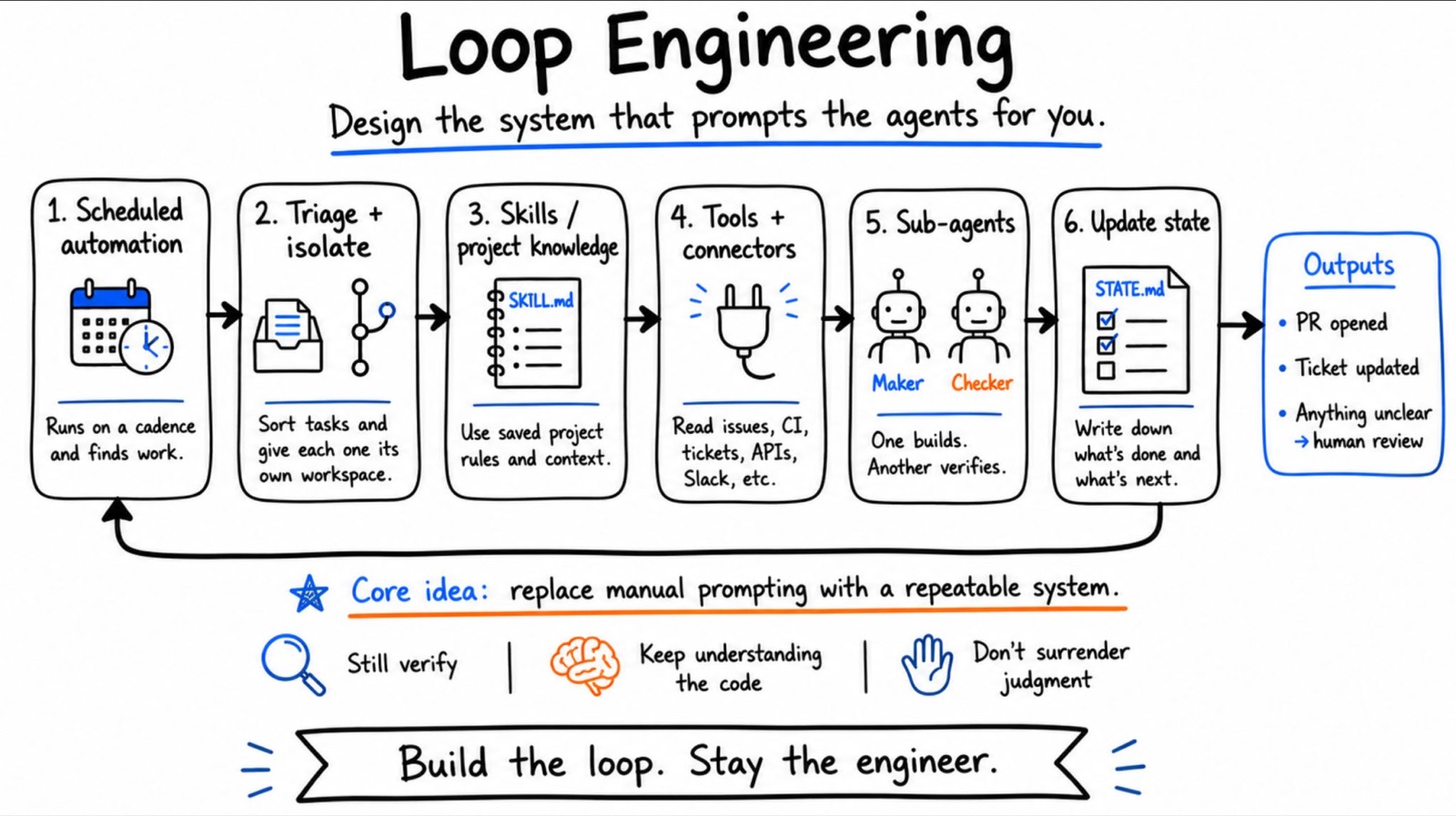
A loop, properly built, has six parts, and none of them are exotic:
-
01A schedule.It runs because the clock says so, not because I remembered to check in on it.
-
02A queue.It finds its own work — my client pipeline, my project database — instead of asking me what to do.
-
03A brain on file.Its rules, voice, and guardrails live in a written playbook it reads every run. Train the employee once; stop re-explaining the job.
-
04Connections.It reads the real systems — my email threads, my records — instead of my memory of them.
-
05A checker.Before anything reaches me, a second pass attacks the first draft: prove every claim, cite the source, flag what's uncertain. The maker makes; the checker doubts.
-
06A memory.Each run writes down what it did and what's next, so the next run resumes instead of restarting.
Who Benefits from You
Staying the Grunt?
Be suspicious of how good being the bottleneck feels. Founders love being the hub — every decision routed through us, every draft touched by our hands. It feels like you matter. But, it's actually the most expensive habit in the building, because the hours spent re-prompting, re-explaining, and re-checking are the exact hours that were supposed to go to the work only we can do.
The software economy isn't in a hurry to fix this, either. A tool you must open every day is a tool that gets renewed. The feed wants your attention; so does the dashboard. Very few products are designed to not need you, because not needing you is bad for engagement. Loops are something you truly have to build for yourself — which is precisely why they're worth building.
What One Day of
Looping Bought Me.
In one working day, my shop went from zero production loops to five. This is what now happens without me:
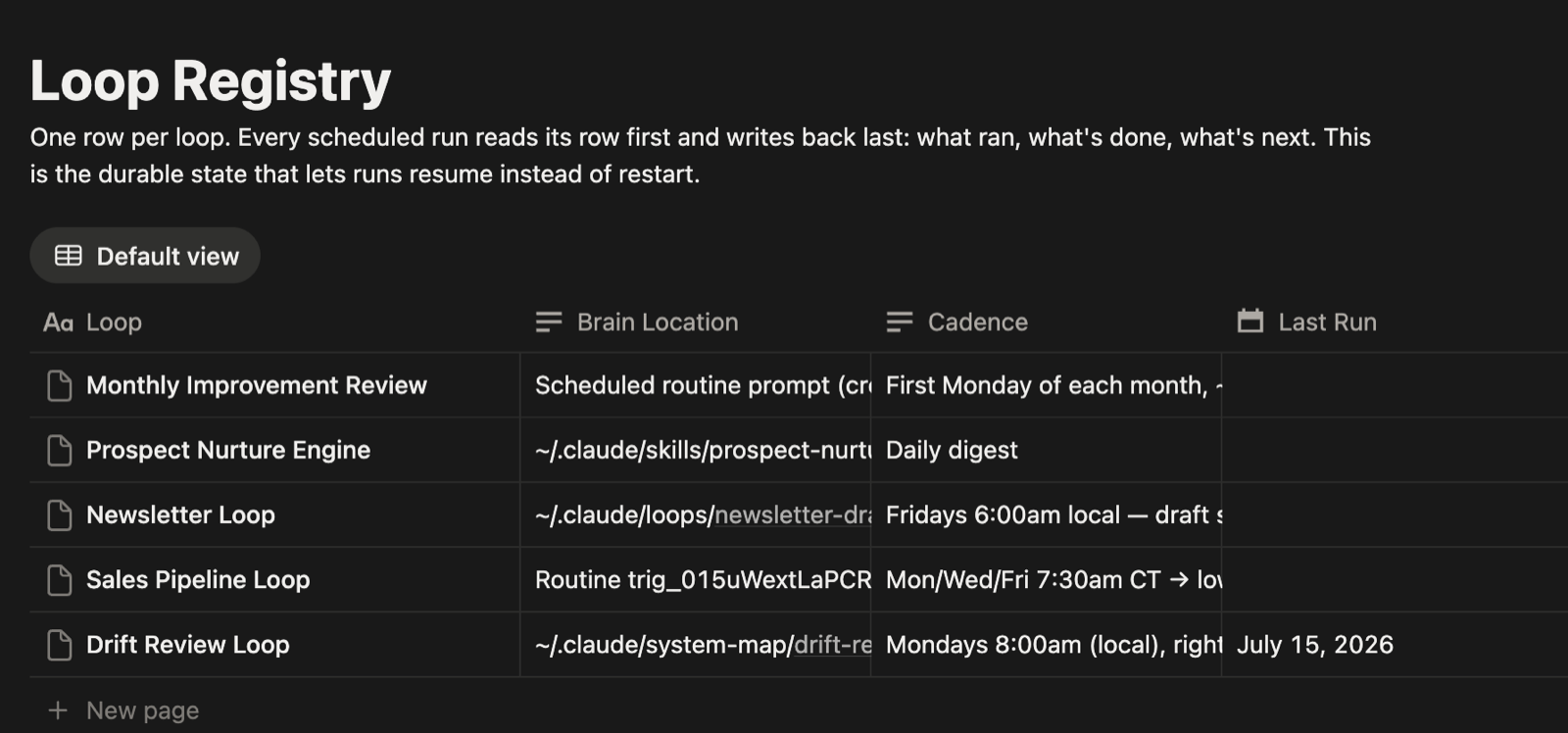
Friday, 6:00 a.m. — a draft of my weekly newsletter gets researched and written: a real statistic with a live citation, a tool worth knowing, the full issue in my voice, plus the companion social post. Staged, never sent. My edit pass is the gate.
Friday, 7:31 a.m. — my sales pipeline gets scanned. Every prospect record is checked against the actual email threads — not my optimistic memory of them. Stale records get corrected and marked as machine-touched so I can see exactly what the system changed. Where a follow-up is due, one is drafted — in my voice, under my follow-up playbook — and parked in my drafts folder, ready to send or delete. It cannot send. Ever. That button stays in my hands.
Monday, 8:00 a.m. — the drift review that used to end by assigning me an hour of homework now just does the homework: a full reconciliation, prioritized findings, proposed fixes. On its verification run it found real problems in ten minutes and — this is the part I respect — refused to fix them without me. (Data sovereignty is a big thing for me if you can't tell)
First Monday of the month — a fifth loop audits the other four. Which ones ran. Which outputs I approved, which I rejected, which I ignored — because a loop whose work I keep ignoring isn't saving me time, it's generating polite noise. It recommends: upgrade, keep, or kill. A system that can propose its own funeral is a system you can trust.
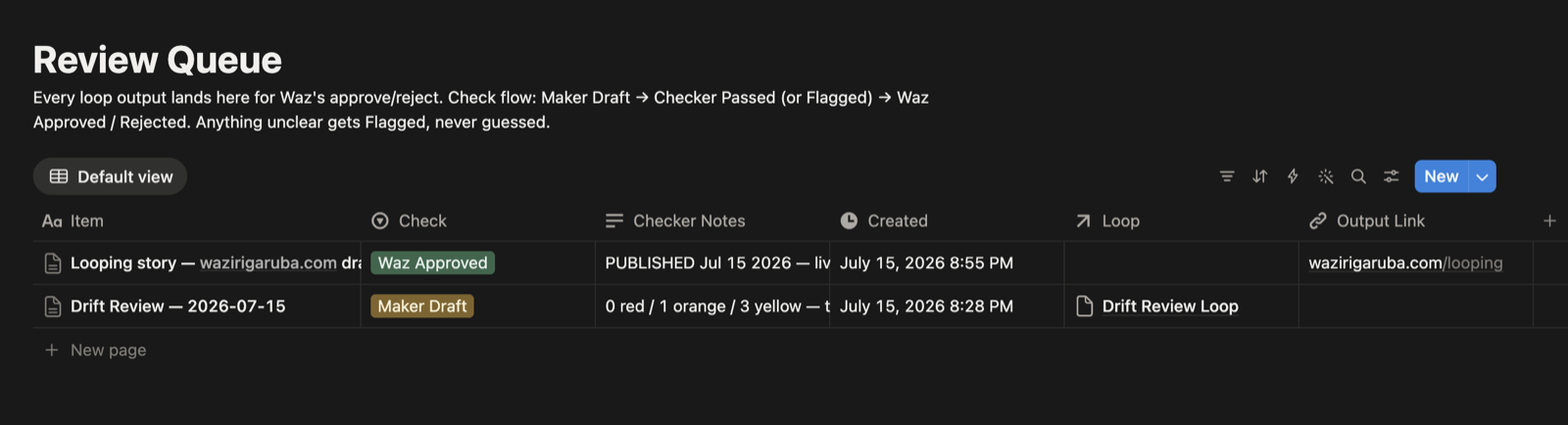
And all of it lands in one place — a single review queue — where every item waits with its evidence attached: here's what I changed, here's why, here's the thread I read. I approve, reject, or answer a flag. Minutes, a few times a week, saved for me to spend with my family, or enjoying a bowl of Egusi soup.
The honest math: the drift reconciliation was an hour a week when I actually did it. Pipeline hygiene and follow-up writing, two to three more. Newsletter research and drafting, another two to three. Call it six to eight hours of attention a week, back — not to leisure, mostly, but to the work that actually compounds. The honest caveat: I had a year of plumbing underneath — records in order, connections wired, playbooks written. The loop layer itself took a day. If you have no plumbing yet, your first loop will be humbler.
Build it anyway.
The Long
Arc.
In 1788, James Watt bolted a governor onto his steam engine — two brass balls on a spinning shaft. If the engine runs too fast, the balls fly outward and close the valve; if too slow, they drop and open it. It was the first famous machine that watched itself, and it mattered more than the steam did. Steam was power. The governor was power that no longer needed a man standing next to it with his hand on the valve — which is the only kind of power that scales.
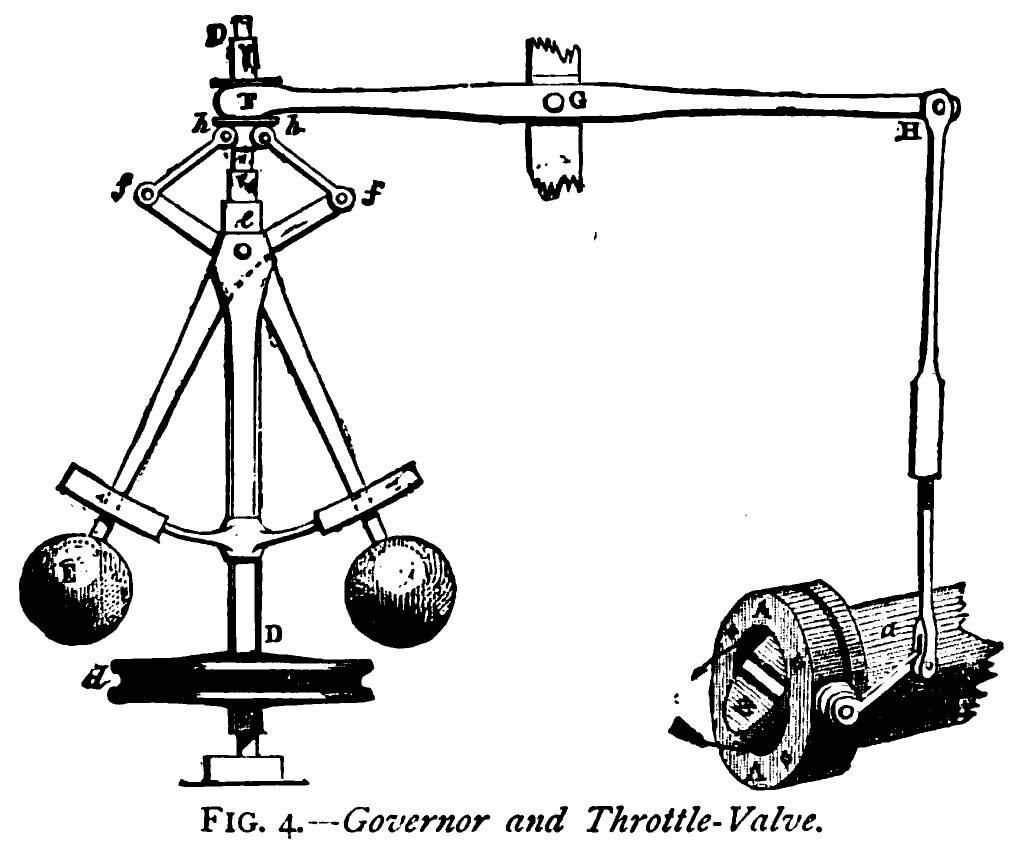
Every era of tooling repeats this. The engine, then the governor. The computer, then the scheduler. Now: the model, then the loop.
I named my whole stack GRIOT, after the West African keepers of the record — and I've learned the record alone isn't enough. The griot didn't recite the village's history once; the griot returned with it, season after season, on a rhythm everyone could build on. The record keeps the truth. The loop keeps the rhythm.
The
Choice.
You're already in a loop — the question is your role in it. Every week you re-do the same triage, re-chase the same follow-ups, re-compile the same report, you are a component: reliable, uncompensated, and tired. The alternative isn't a bigger AI subscription. It's one deliberate hour spent turning one recurring chore into a system that drafts while you sleep and waits for your yes.
Start with one. Here's the prompt — paste it into Claude, ChatGPT, or whatever you use:
I want to design my first self-running loop, and I want you to act as my
systems engineer. Interview me — one question at a time, five questions
max — to find ONE piece of work I redo by hand every week (examples:
chasing follow-ups, tidying records, compiling a report, drafting a
recurring update). Then design my loop on one page:

1. WHEN it runs and what triggers it
2. WHERE it finds its work each time
3. THE PLAYBOOK it follows — rules and voice written so a stranger
   could execute them
4. THE CHECKER — how a second pass verifies the output against real
   evidence before I ever see it
5. THE GATE — the one place finished drafts wait for my approval;
   nothing sends, posts, or changes anything without my explicit yes
6. THE MEMORY — the note it leaves itself so the next run resumes
   instead of restarting

Finish by giving me the smallest manual version I could run this week,
before any automation exists.
That last line is the whole philosophy in miniature. You don't automate a process you've never run by hand — you'd just be manufacturing chaos on a schedule. Run the loop manually once. Feel where it creaks. Then hand it the keys, one guardrail at a time, and keep the approve button under your thumb.
Build the Loop.
Remain the Architect.
Friday morning, two of my loops will fire before my alarm does. The newsletter draft will be waiting. The follow-ups will be sitting in my drafts folder with the evidence attached. And the final word on every one of them will still be mine — which is exactly the point.