PATTERNS · 9 ENCODED
KIT · SHAREABLE
The Three Deaths
of a Project.
For a year an AI has managed my projects.
The interesting part isn't the AI. It's why the projects stopped dying.
Ninety-Four
Open Loops.
On a Saturday in July I sat down with Claude and did something I had been avoiding for years: we counted. Every project folder on my machine, every half-built idea, every "I'm still working on that" I was carrying went into one workbook.
Ninety-four open items.
Client builds next to kids' projects next to a board game next to three separate attempts at the same folder cleanup. Every one of them had been alive once. Every one had a day when it was the thing I was most excited about. And not one of them had a funeral — no decision, no ending, no moment where I chose to stop. They just went quiet.
I Thought I Was
the Problem.
The story I told myself was the one you tell yourself: discipline. If I were more serious, more consistent, more like the people in the productivity videos, the loops would close.
Then, over the past year, an AI gradually became my project manager — booking my work onto the calendar, checking in, keeping records — and I got to watch, in the logs, what actually revived dead projects. Here is the finding: not one fix involved becoming a better person. Every fix removed a specific friction, at a specific moment, in a specific place. The diagnosis was never character. It was engineering.
Because projects don't die of laziness. They die in one of three places. At the start — the project stays a wish, and sessions never begin. In the middle — it launched hot, and by week two it fades, because progress went invisible. At the end — 90% done, sometimes for years, because the finish quietly became optional.
And notice who profits from the other story. An entire industry — the planners, the streak apps, the discipline courses — bills you annually for the belief that the problem is your character. Character can be monetized forever. A removed friction is removed once, for free. That's why nobody sells it to you.
The First Death:
The Wish.
A project without a scheduled hour is not a plan. It is a wish with a checkbox. The first thing my system does with any new commitment is refuse to let it stay abstract — three moves, in order.
First, the interview. When I bring an idea, the AI doesn't hand me a plan. It asks me one question at a time — what matters, what done looks like, when I honestly have the hours — and lets each answer shape the next question. I've written about this before, and it holds: a plan you were interviewed into is your plan. A plan you were handed is homework.
Second, the block. Everything we agree on goes onto the calendar on the spot, with a day, a time, and a place. Behavioral scientists call this an implementation intention, and it is the most replicated finding in the follow-through literature: "Tuesday, 7pm, kitchen table" gets done at rates "sometime this week" never touches — because the decision was made once, in advance, when it was cheap.
Third — the one that changed everything — the note inside the block. No bare calendar events, ever. Every block carries three lines in its description: the exact first action for the first two minutes, where the work lives, and what "done for today" means.
BLOCK ......... The Deck · kitchen table · 90 min
FIRST ACTION .. open slide 9 — fix the broken chart
THE WORK ...... ~/Projects/pitch/deck-v3.key
DONE TODAY .... slides 9–12 rough, nothing pretty
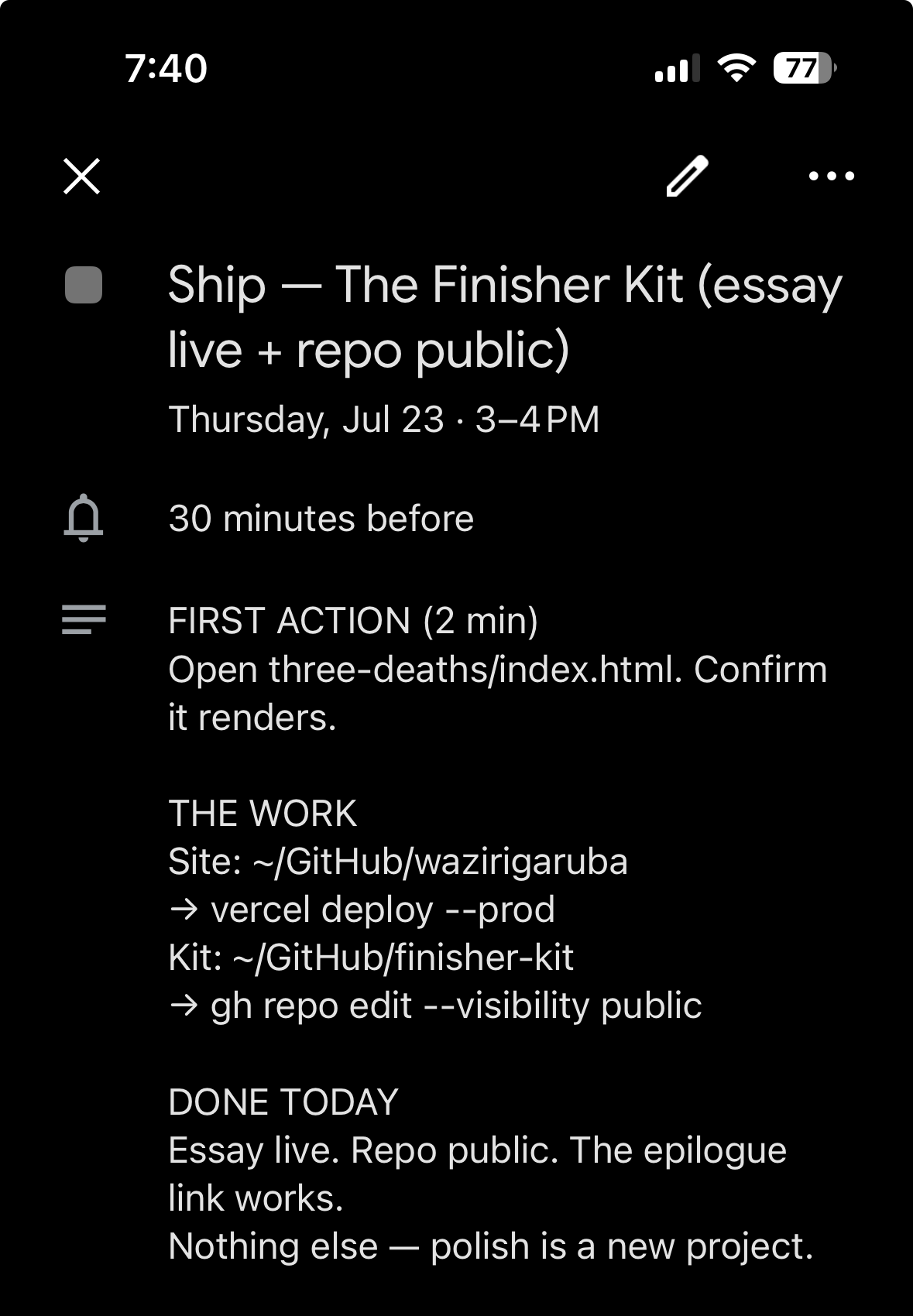
The expensive part of any work session was never the work. It was ignition — the "now where was I?" tax you pay while cold. I used to lose whole evenings to it. Now the note pays that tax in advance, written by the system at the moment I was warm.
The Second Death:
The Fade.
Week two is where most projects actually die. Not in a decision — in a fade. The novelty is spent, the progress went invisible, and nothing in your day ever asks about it. This death needs four countermeasures, and my system runs all of them without me.
-
01The day arrives pre-decidedAt 7am my phone buzzes with a slate: what's on deck with its exact next action, which projects are due a check-in, one older project in the spotlight so nothing rots quietly. I never spend morning willpower deciding what matters. Deciding is the tax; the slate pays it.
-
02The score stays where I can see itWhen I was filling seats for a course, the scoreboard was one line: seats confirmed versus days remaining. Visible progress accelerates — economists call it the goal-gradient effect. Most abandoned projects were still moving when they died; nobody could see it, that's all.
-
03Accountability lives where my life already happensMy training plan is written into the calendar event before I reach the gym; the results get logged onto the same event after — the ✓ and the ✗ both stay on the record. The system met me at the squat rack, not in an app I'd have abandoned by February. New habits survive by riding old ones.
-
04Anything I say twice becomes lawCorrect the system twice — "stop scheduling me at 9pm," "skip the pep talk, give me the score" — and it writes the rule into its own memory. My standards compound instead of evaporating. This is why week six feels easier than week one, instead of harder.
① ON DECK ..... 3 items · next action included · no deciding
② CHECK-INS ... 2 due · oldest first
③ SPOTLIGHT ... 1 of 27 · rotating · nothing gets to hide
The Third Death:
Ninety Percent.
The cruelest death happens in sight of the finish line. The hard problems are solved, the pressure is gone — and the definition of done has quietly grown, because every good idea from week three got promoted to "part of the project." You are never done because done keeps moving.
So done gets frozen on day one: three to seven boxes, each one checkable by a stranger. Every idea I have mid-project goes to a list called LATER — it isn't rejected, it's just correctly identified as a new project. And near the end, the system schedules the final block: a session whose only job is to finish. Not improve. Finish.
Then comes the part I'd never done in my life: the ending ritual. The work gets swept off the workbench into wherever finished things permanently live. And the system interviews me one last time and writes the win story — one page, before and after, in my own words, quoting the reason I gave on day one back to me.
That last piece sounds sentimental. It's the most mechanical part of the whole machine. Psychologists call it the peak-end rule: you remember an experience by its peak and its ending, not its average. End a project with a documented win and your memory files the whole thing under I finish what I start. That identity — not the plan, not the app — is what starts the next one.
The Oldest Trick
in the Book.
Three thousand years ago, Ulysses wanted to hear the sirens' song and live. Every sailor before him had relied on willpower, and every one of them was at the bottom of the sea. Ulysses did something different. He didn't train harder or vow deeper. He put wax in his crew's ears and had himself tied to the mast — he made the decision while he was strong, and built a ship that would hold it when he wasn't.
Behavioral economists cite that story as the first commitment device in literature. Sailors would have called it seamanship. Either way, the lesson survived thirty centuries: the people who get past the sirens are not the ones with the strongest will. They're the ones who changed the ship.
Every pattern in this essay is a mast. The block with the note inside it. The 7am slate. The visible score. The frozen definition of done. None of them make me stronger; all of them hold decisions I made when I was.
And the receipts are on this website. In the past year: platforms for each of my kids, with their own guidebooks. Voice agents doing real work for real businesses. A health system that got me back under a bar at forty-six. The site you're reading. Same person who was carrying ninety-four open loops. Different ship.
This One
Is Yours.
I bundled the nine patterns into something you can take with you. It's called The Finisher Kit — a small, free package that turns the Claude you already have into the project companion I've been describing: it interviews you about one stuck project, books the work onto your real calendar with the note that lets you start cold, keeps your score visible, checks on you on days 3, 7, 14, 21, and 30, defends your definition of done against your own new ideas — and when you cross the line, writes the win story with your name on it.
There's a zero-install path: one page you paste into any Claude conversation, and thirty minutes later you've done the first real work on your project and your next session is on the calendar. If that lands, the full kit takes five minutes.
Everything is at wazirigaruba.com/kits — importable workflows, starter repos and the playbooks, free and without an email. Take it, run it, make it yours.
Pick the project that would sting most to abandon. You already know which one it is — you thought of it somewhere around Act I. Run Day One tonight.
Next: The Interview →
← Back to Wazirigaruba.com